Most Bible readers skim past Azmon without a second thought. It appears in a single verse—Numbers 34:4–5—as a waypoint on the southern boundary of the Promised Land, sandwiched between the ascent of Akrabbim and the Brook of Egypt. That’s it. A name on a map, a place long vanished. Yet for anyone who takes geography seriously。Azmon isn’t just a dot on an ancient boundary list. It marks the edge of something: the line where the wilderness begins, the limit of settled territory, the point beyond which the Israelites were told not to go. I first stumbled on Azmon while tracing the “way of the spies” in my own reading, and what struck me was how deliberately the text anchors a theological promise to a physical landscape.The location of Azmon remains debated. Some scholars place it near modern-day Ein Qadis, a spring on the Sinai border roughly thirty miles south of Beer-sheba;others suggest a site closer to the Wadi el-Arish, the biblical Brook of Egypt. The name itself—possibly derived from a Hebrew root meaning “strong” or “fortified”—offers little help. What we do know is that Azmon functioned as a pivot point. From there, the boundary turned toward the brook and ran to the sea. In practical terms, that meant any traveler heading north from the desert had to pass through Azmon’s vicinity to enter the hill country. It was a threshold, not a destination. I find that telling. The Bible often marks boundaries with obscure places。as if to remind us that the edges of promise are just as real as its center.Archaeology hasn’t been kind to Azmon. No signed pottery, no monumental gate, nothing that screams “Here lies Azmon” The Sinai survey work of the 1970s and 80s uncovered scattered Iron Age encampments and a few watchtowers in the region。
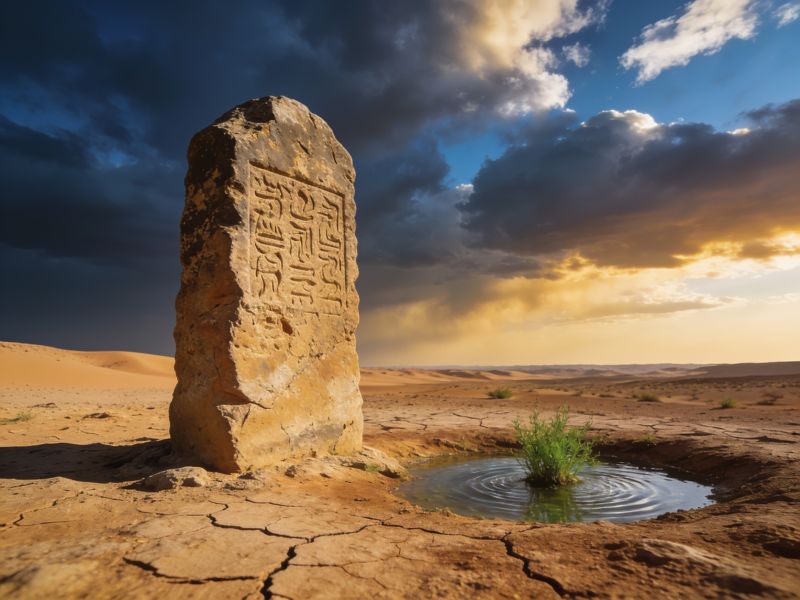
but nothing that can be confidently tied to the biblical site. That silence can feel disappointing. Yet it also fits the character of a border town: ephemeral, functional, rebuilt and abandoned as frontiers shifted. I’ve walked similar tells in the Negev, and the absence of grandeur is itself a kind of evidence. Azmon wasn’t a city of gates and palaces. It was a place where shepherds crossed, where smugglers might have slipped through, where the line between “inside” and “outside” was enforced by geography more than by walls.The theological weight of Azmon lies in its role as a limit. Numbers 34 defines the land’s extent with a series of landmarks, and Azmon sits near the southwestern corner. Everything south and west of it belonged to other peoples—Egyptians, Amalekites。desert nomads. For Israel, Azmon was a reminder that the promise had borders. That idea unsettles modern readers who prefer their blessings unbounded. But there’s honesty in a bounded promise. It says: this is the place I’ve given you;tend it, defend it, don’t covet what lies beyond. Azmon, obscure as it is, embodies that discipline. I suspect the original audience knew exactly where it was—a spring, a cairn, a seasonal camp—and that familiarity made the boundary real in a way a general “from the wilderness to the sea” never could.
Today, the area around biblical Azmon is a patchwork of military zones, Bedouin settlements, and nature reserves. The spring at Ein Qadis still flows, and hikers on the Israel National Trail pass within a few miles of the likely site. It’s easy to drive past without noticing. But stop at the roadside, look south toward the vast open spaces of Sinai, and you get a sense of what Azmon meant: a thin green line against the desert。a place where promise met wilderness and held its ground. That’s not a bad legacy for a name that appears only once.